
Actively align with the “15th Five-Year” Plan to explore business opportunities
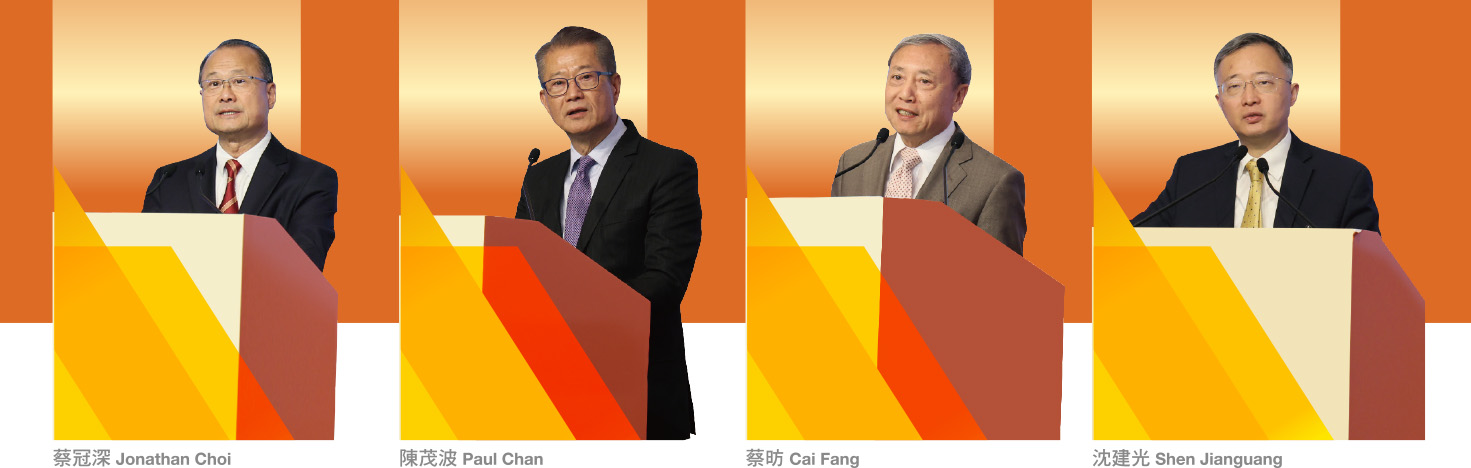
As this year marks the first year of the implementation of the national “15th Five-Year” Plan, Jonathan Choi, Chairman of the Chamber, pointed out that the Central Government attaches great importance to Hong Kong and fully supports it in strengthening its role as an international financial, shipping and trading center, promoting the development of an international innovation and technology center, and further highlighting Hong Kong’s important role positioning.
He emphasized that the Hong Kong business community should actively align with the “15th Five-Year” Plan, strengthen its role as a hub connecting the Mainland and overseas, enhance the competitiveness of modern service industries, establish a cross-border capital and investment platform to provide comprehensive support for Mainland enterprises. Meanwhile, it should strengthen cooperation with the Guangdong-Hong Kong-Macao Greater Bay Area (Greater Bay Area), the Beijing-Tianjin-Hebei Region and the Yangtze River Delta to promote the coordinated development of high-end service industries.
Paul Chan:
Adopt a combination of stability and adaptability to address challenges
Paul Chan, Financial Secretary, stressed that Hong Kong should adopt a combination of stability and adaptability to address current challenges. He explained that Hong Kong’s stability lies in the advantages of “One Country, Two Systems”, free port and zero tariff, making it the preferred investment destination for enterprises from the Mainland and around the world. Regarding adaptability, even in the context of rising protectionism and unilateralism, the country has strengthened high-level opening-up to the outside world and encouraged enterprises to “go global”. Hong Kong can join hands with relevant provinces and cities in the Mainland to “go global”. As this year is the first year of the “15th Five-Year” Plan, China will expand high-level two-way opening-up and achieve a high level of self-reliance and self-improvement. Hong Kong should continue to act as a “Super Connector” and a “Super Value-adding Partner” to better serve the country.
Fostering competitive innovative sectors is a top priority at present. Chan believes that innovation and technology can not only become a core industry, but also empower the upgrading and transformation of traditional industries. Meanwhile, the Northern Metropolis is an important carrier for Hong Kong’s innovation and technology development and a key base for Hong Kong’s cooperation with cities in the Greater Bay Area. He pointed out that the HKSAR Government is accelerating the construction of the Northern Metropolis in an all-round way, with a flexible development model, dedicated legislation, administrative streamlining and preferential investment packages to attract high-value-added industries and high-potential enterprises to settle in the Northern Metropolis, bringing in technologies, employment opportunities and related high-value-added manufacturing industries.
“Investing in people” supports Chinese-style modernization
In 2023, the country put forward the important concept of “high-quality population development”, emphasizing the need to better combine “investing in physical assets” and “investing in people” to support Chinese-style modernization through high-quality population development. Cai Fang, Academician of Chinese Academy of Social Sciences and Standing Committee Member of the 13th NPC, stated that this concept will be further implemented in the “15th Five-Year” Plan.
With the new changes in China’s population situation, Cai pointed out that the return rate of the traditional growth model driven by large-scale physical investment tends to decline, and the economy needs to find new growth drivers. Meanwhile, external demand is affected by factors such as the headwinds of globalization, and the decline in investment returns has also restricted the sustainability of the traditional development path. Against this backdrop, the previous development model focusing on “investing in physical assets” needs to be adjusted, and “investing in people” will become a new growth driver. From an economic perspective, promoting consumption crucially requires increasing the supply of basic public services, alleviating families’ worries, and making residents willing and bold to consume.
Cai suggested that “investing in people” should be carried out in four aspects: first, establishing a comprehensive welfare system supporting childbirth to address the challenge of low fertility rate; second, increasing investment in education at all levels to enhance human capital in response to competition from artificial intelligence; third, improving the labor market to resolve structural employment conflicts; fourth, reforming the old-age security system to adapt to the changes in production and life brought about by artificial intelligence.
Shen Jianguang:
Optimistic about Mainland’s economic prospects in 2026
Shen Jianguang, Chief Economist and VP of JD Group and Dean of JD Economic Research Institute, expressed optimism about the economic prospects of the Mainland in 2026. The recovery of infrastructure investment growth, the sustained resilience of exports and trade diversification, coupled with the upgrading of the manufacturing industry, will provide certain support for the economyus. The “15th Five-Year” Plan has also made clear adjustments and optimizations in various aspects, including focusing on economic construction, maintaining a relatively rapid economic growth rate, emphasizing the integrated development of scientific and technological innovation and industrial innovation, expanding the strategic focus of domestic demand, and fully boosting consumption, especially service consumption.
Shen further pointed out that the Central Economic Work Conference has released a series of policy signals, including paying more attention to releasing potential and stimulating vitality, improving the effectiveness of macro policies, optimizing existing policies to expand domestic demand, focusing on the integrated development of scientific and technological innovation and industrial upgrading in developing new quality productive forces, promoting long-term and institutionalized “anti-involution”, emphasizing trade diversification and independence in foreign trade, focusing on the long-term mitigation of risks in the real estate market, and promoting coordinated development and common prosperity through platform policies.
He predicted that this year, the Mainland will increase fiscal input to promote consumption, improve consumption capacity, increase public service expenditure, relax market access, expand service consumption, build a number of consumption drivers with broad influence, improve the institutional mechanisms for promoting consumption, establish and improve systems adapting to new consumption formats and models, and vigorously boost consumption and build a strong domestic market will become important policy directions.
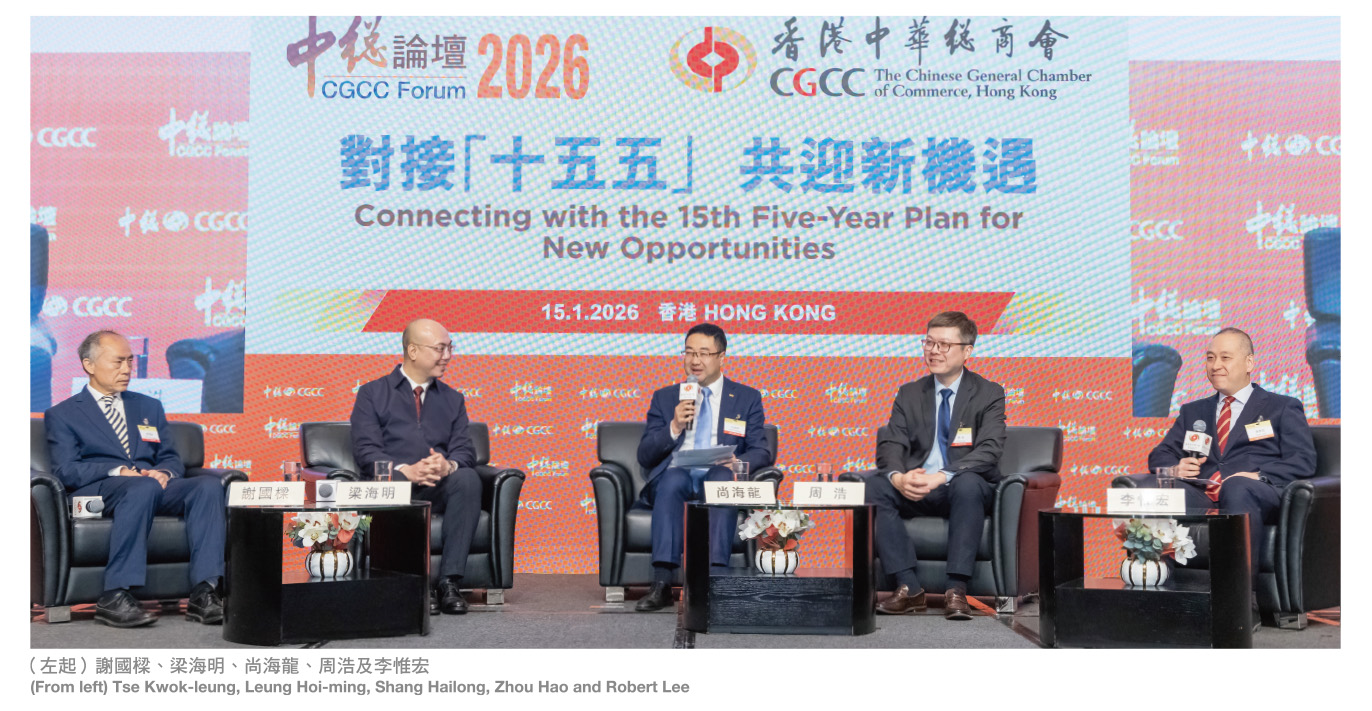
Panel Discussion:
Hong Kong’s Role and Opportunities in the “15th Five-Year” Plan
Shang Hailong:
Seize AI industry opportunities and strengthen innovation collaboration
Shang Hailong, Co-founder & Chief Strategy Officer of SenseCare Smart Health Tech, believes that for Hong Kong to seize the opportunities brought by national development during the “15th Five-Year” Plan period, the key lies in focusing on three directions: domestic demand, science and technology and industry. In terms of finance, Shang holds that Hong Kong should consolidate its status as an international financial center and actively expand offshore RMB business. At present, the scale of RMB M2 in the Mainland is huge, while Hong Kong’s offshore RMB market still has great room for development. In terms of innovation and technology, Hong Kong must focus on the artificial intelligence industry, strengthen innovation collaboration with the Greater Bay Area, and promote the transformation of scientific research achievements into practical benefits. He suggested that the government and the public should actively invest in the AI industry.
Leung Hoi-ming:
Take the Initiative to Assume the Role of “Super Partner”
Leung Hoi-ming, Dean of the Belt and Road Research Institute of Hainan University, holds that the country will more actively and systematically link the domestic and international markets. Meanwhile, the country fully supports Hong Kong in better integrating into and serving the overall national development. Leung explained that Hong Kong has long been an important window for the country to connect with the international market and needs to take the initiative to assume the role of “Super Partner”. The upgrading of this role means that Hong Kong should share development responsibilities with other cities in the Greater Bay Area, Hainan Free Trade Port, etc., actively participate in industrial planning, technological research and development and rule alignment, and promote regional coordinated development and institutional innovation.
Zhou Hao:
Promising financial opportunities for Hong Kong
From the perspective of investment banking, Zhou Hao, Chief Economist and Head of Research of Guotai Junan International, believes that Hong Kong can seize opportunities in four aspects: first, continue to exert the function of an international financial center to provide a financing platform for Mainland enterprises; second, align with the national scientific and technological innovation strategy to support innovation and technology enterprises in listing in Hong Kong; third, connect with the upgrading of the Mainland manufacturing industry, combine with Hong Kong’s advantages in modern service industries to achieve a “1+1>2” effect; fourth, assist mainland enterprises in “going global” while driving the development of Hong Kong’s local finance, technology, employment and talent.
Tse Kwok-leung:
Actively align with the “15th Five-Year” Plan
Tse Kwok-leung, Senior Research Fellow (Honorary) of Lau Chor Tak Institute of Global Economics and Finance (IGEF), The Chinese University of Hong Kong, holds that for Hong Kong to actively align with the “15th Five-Year” Plan, the top priority is to maintain an open and free business environment and a financially connected international market. In terms of innovation and technology, Hong Kong also needs to cooperate with the development of the Mainland, link up with the Guangzhou-Shenzhen Science and Technology Innovation Corridor, leverage its advantages in professional services to provide various supports such as certification and overseas sales for related technologies, and connect with the innovative industries in the Mainland. In addition, Hong Kong should expand and strengthen the RMB trading market, continuously expand RMB business, optimize the capital arrangement of RMB business, and promote the internationalization of RMB.