
Hong Kong Committed to Building a Regional IP Trading Centre
According to a research report published by the Intellectual Property Department (IPD), IP-intensive industries accounted for over 32% of Hong Kong’s Gross Domestic Product between 2019 and 2021. Between 2022 and 2024, the HKSAR Government granted an average of over 10,000 standard patent registrations annually, with the current total number of valid patents exceeding 75,000. This reflects the growing vibrancy of the city’s upstream innovation and technology ecosystem, as well as the enormous market and value potential of IP trading.
IP occupies a strategic position in global economic development
“The global economy is rapidly transforming towards a development model centred on creativity, technology and innovation, where intellectual property is the key to corporate competitiveness,” emphasized David Wong, Director of the IPD. He noted that the HKSAR Government has rolled out multiple measures in recent years to strengthen Hong Kong’s IP ecosystem, including the Original Grant Patent system and the “Patent Box” tax incentive.
Hong Kong is making full strides in the IP field, and the next step is to progressively promote the development of IP financing. However, unlike traditional financing methods that use tangible assets such as land, properties and machinery as collateral, Wong pointed out that using IP assets for financing presents several challenges, including difficulty in valuation, insufficient market references, low liquidity and gaps in market understanding of intangible asset values.
Launching support measures to build an IP financing ecosystem
To address the above pain points and help enterprises unlock the potential of their IP assets, the 2025 Policy Address announced a number of targeted measures aimed at building a comprehensive support system. These include an IP Financing Sandbox launched by the Hong Kong Monetary Authority in collaboration with the Commerce and Economic Development Bureau and the IPD.
Wong explained that the scheme adopts a “trial-and-test” approach. In a risk-controlled environment, it invites and encourages banks, enterprises with rich IP portfolios, valuation service providers, legal professionals and other experts to participate in testing financing arrangements based on IP assets (such as patents, trade marks and copyright). “Through the sandbox scheme, we will gain a better understanding of the actual operational situation of IP financing, collect views and accumulate practical experience, so as to better meet the needs of innovative enterprises,” he added.
All sectors joining hands to drive IP development
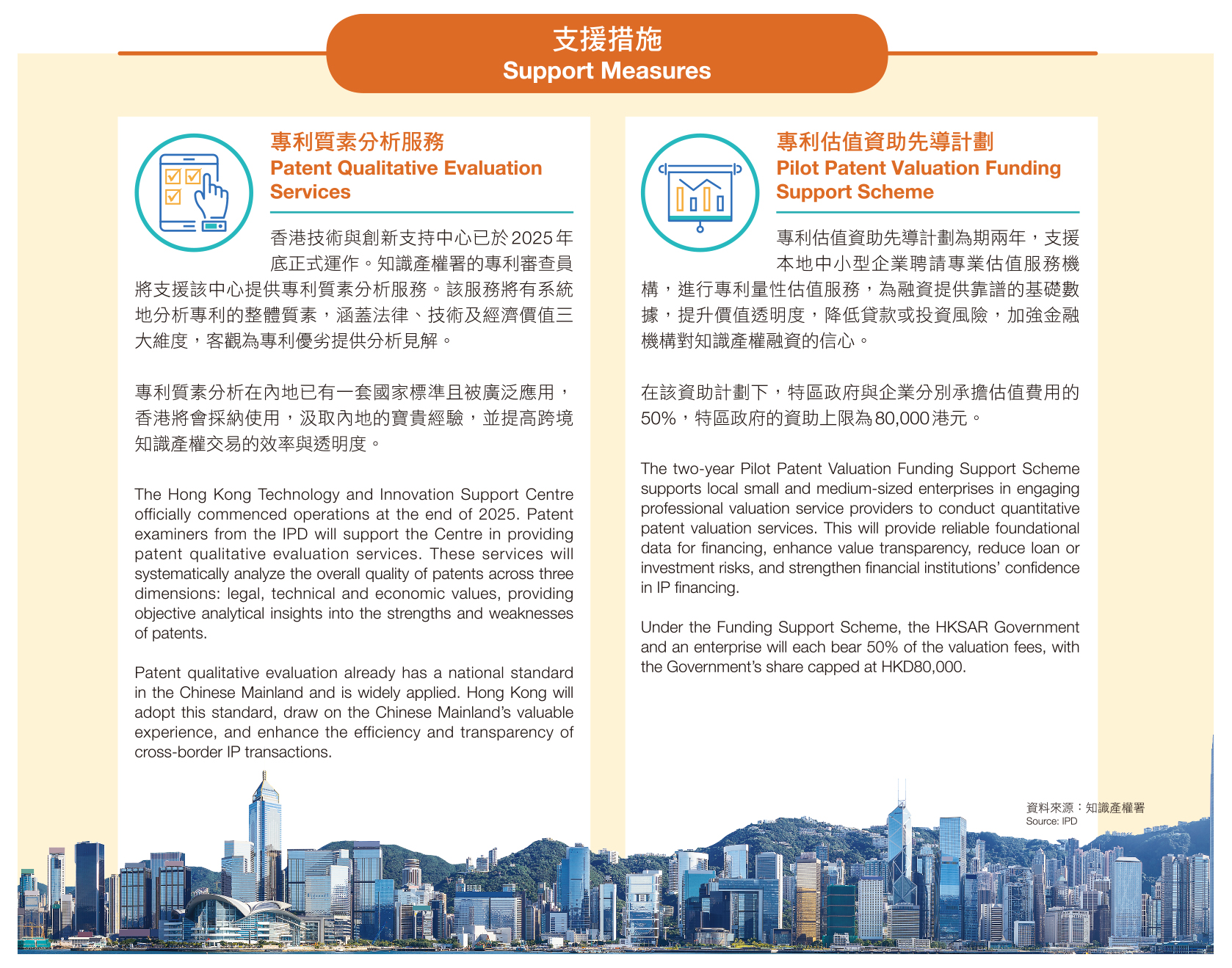
Wong stated that the HKSAR Government plans to take further steps by launching patent qualitative evaluation services and the Pilot Patent Valuation Funding Support Scheme (for details, refer to the table below). The former aims to help enterprises gain an in-depth understanding of the multi-dimensional aspects of patents, while the latter provides enterprises with specific asset value figures. He believes that the combination of the two will provide a more solid foundation for financial institutions’ credit decisions.
At the same time, the HKSAR Government is actively enhancing training for the banking sector and implementing a multi-pronged external promotion strategy, such as hosting international exchange activities, to gradually build a sound ecosystem conducive to the development of IP financing.
In December last year, the HKSAR Government, together with the Hong Kong Trade Development Council, co-hosted the 15th edition of the Business of IP Asia Forum, attracting over 3,300 participants from 38 countries and regions, and creating an international exchange platform for Hong Kong’s IP financing opportunities and policies. Wong is confident that Hong Kong has enormous potential for development in the IP field in the future. The HKSAR Government will continue to collaborate with the industry to actively explore further ways to use IP to drive economic development and strive to build Hong Kong into a regional IP trading centre.
Heiwai Tang
Promoting Intellectual Property Trade to Boost the Economy
The “14th Five-Year Plan” outline clearly positions Hong Kong as a development center in eight key areas, demonstrating the country’s confidence in Hong Kong’s advantages and a forward-looking positioning for market development. To align with the national strategic plan, the government has actively invested in deployments, with evident results.
Heiwai Tang, Associate Vice-President of the HKU and Director of the Asian Global Institute, elaborates that common intellectual property mainly covers two major categories: patent rights for technological innovations, research achievements or inventions, and copyrights that include cultural and creative works, artistic and cultural creations, and even trendy toy IP brands.
“Looking back at Hong Kong’s cultural exports in films, television and music during the 1980s and 1990s, it has fully demonstrated the vigorous development and maturity of Hong Kong in this type of intellectual property, copyrights. However, many patent rights, including university research achievements, are often in the basic research and development stage, with few projects landing and being commercialized. In recent years, under the support of multiple policies, improvements have been seen.”
Strong local R&D capabilities
In 2025 alone, six universities in Hong Kong, supported by the government’s “InnoHK1 + Scheme,” have a total of 25 innovation and technology research projects selected, advancing towards commercialization goals. Tang believes that Hong Kong does not lack innovative and practical local research, with enormous market development potential for commercialization. However, since these innovative R&D projects do not yield results overnight, it may deter market investors and hinder development progress, leading to a vicious cycle.
“The government is determined to promote intellectual property trade and plans to launch an intellectual property financing sandbox pilot program to assist industries in need to utilize intellectual property for financing, eliminating the current pain points in the innovation and technology sector. This is an excellent attempt and development direction.”
Abundant talent in Hong Kong beneficial for development
With the implementation of the sandbox pilot program, the SAR government has also promptly launched a two-year patent valuation subsidy pilot scheme, aimed at subsidizing enterprises to find suitable service providers for valuing their own intellectual property products. Tang believes that the current definition of intellectual property is broad, and early-stage financing is difficult, requiring cross-sector professionals from law, banking and so on to collaborate for success.
“Hong Kong has a stable legal system, a good business environment, and no shortage of professionals with international connections and rich experience. It can be said that the development conditions are in place, with talent fully prepared, absolutely having the potential to develop into a regional intellectual property trading centre.”
Assisting Mainland enterprises to go global and attract foreign investment
Amid the current volatile geopolitical situation, Tang states that Hong Kong, backed by the country’s innate superior conditions, can flexibly leverage its development advantages as an international financial and trade centre, combined with world-class professional services, to help Mainland enterprises’ intellectual property products or R&D enter the international market. It can also assist overseas related technologies and products to enter the market in compliance with Mainland regulations, achieving a win-win situation. He emphasizes that the country has advocated “Belt and Road” intellectual property cooperation for many years, and in this wave of national strategic development, Hong Kong should seize this major development opportunity to further advance the overall economic development of intellectual property.